
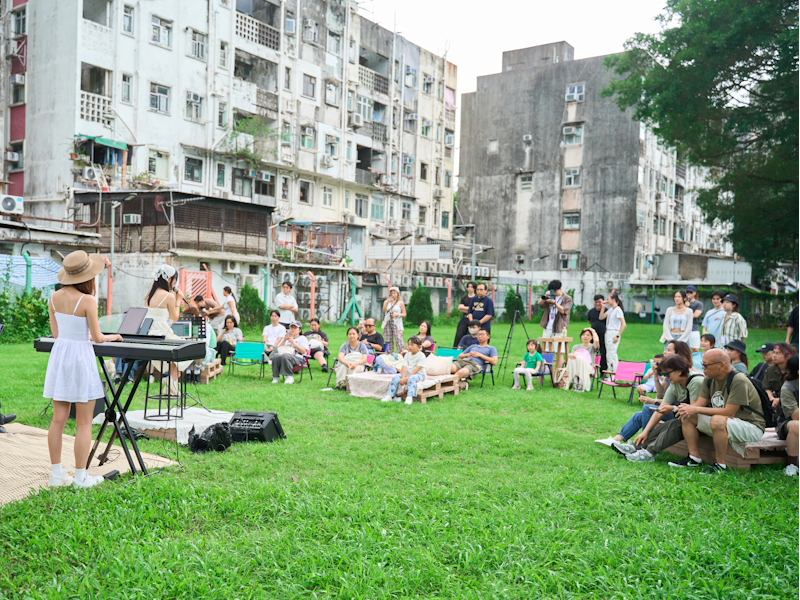
Transformation of a Tai Po Village School
Evangelical Lutheran Church Social Service – Hong Kong


Luk Heung Commons, a new, culture-led placemaking project, officially launched in January 2026. The 30-month initiative, based in Luk Heung Campus in Tai Po, is funded by ZeShan Foundation and co-organized by Happy Ageing Lab Foundation and Evangelical Lutheran Church Social Service – Hong Kong (ELCSS-HK). Through cultural programming, community co-creation, and cross-sector collaboration, the project identifies and utilizes local assets and potential, transforming underused spaces into a vibrant gathering place and collaborative platform for the community.
Luk Heung Commons is located on Plover Cove Road in Tai Po at the former Luk Heung San Tsuen Public School. The school was built on this site in the 1960s to serve the six Hakka villages of Luk Heung that had been relocated to Tai Po to make way for the construction of the Plover Cove Reservoir, and closed in 2006 amid declining student enrollment. Since 2007, the premises have been run by ELCSS-HK as the self-financing Luk Heung Campus, providing social services and continuing to serve the neighborhood.Luk Heung Commons aims to break down the boundaries of traditional social service agencies, and unlock the potential of underutilized spaces and off-hours. The two organizations harness new resources to build the community’s “hardware” and “software,” inviting locals, community partners, arts and cultural workers, social service agencies, academics, and others to participate and co-create. Rather than simply at filling gaps, Luk Heung Commons actively unearths community potential and fosters multi-party exchanges and cross-sector collaboration to discover, create, and share resources together. In doing so, it hopes to meet local needs and create a collaborative platform that can support the growth of the Tai Po community.
Co-Creating Value Through Four Pillars
We use cultural and creative practices as entry points. Through the following four pillars, we build up the resources, skills, and organizational and collaborative capacities of locals and stakeholders, so as to enhance the community’s overall capacity.
- The Community Living Archive organizes teams of Community Ambassadors, publishes community zines, and collaborates with locals to conduct community observations and collaborates with locals on community observations – documenting and cataloguing the stories and histories of Tai Po’s people, events, places, and objects through diverse methods.
- The Community Co-Creation Lab invites community artists and partners to guide locals through creative workshops, using their interests as starting points to collectively shape the venue and neighborhood in diverse ways, thereby fostering a sense of belonging and ownership.
- The Cultural Prescription Station hosts diverse activities, serving as a testing ground for community experiments. Examples include the regular Monthly Kids’ Takeover and Luk Heung Art Market, where community members are actively recruited and supported to participate as partners. Here, arts, culture, and creativity are leveraged to promote healing and strengthen community bonds.
- The Community Incubator Hub actively recruits locals eager to share their creativity. The platform provides comprehensive training and consultation to support them in realizing their ideas and talents through workshops, mini exhibitions, and other activities. This helps participants discover new possibilities for themselves, while the community benefits from innovative services.
Putting these four areas into local practice brings together scattered community resources, promotes mutual aid and partnership, and empowers residents in unlocking their potential. Every partner in these exchanges and co-learning becomes a driving force for healthy community development.
Cross-Sector Collaboration
Cultivating an ideal placemaking project requires bringing together the wisdom and experience of different sectors and residents alike. In the project’s initial phase, we held two brainstorming sessions to introduce the project vision, exchange ideas, and explore partnership opportunities, connecting over 70 professionals from the academic, arts and culture, healthcare, social service, and social innovation sectors. At the same time, we are expanding our community networks through openly recruiting local residents and organizations to become partners. In the first six months of operation since April 2026, the project has already successfully brought together over 40 local residents and organizations as partners, holding over 30 activities totalling more than 160 sessions, attracting over 2,100 attendees. The team will continue working with community partners to organize activities and collaborations, driving deeper community participation and partnership, and putting community-based cross-sector collaboration into practice.
Responding to Local Needs, Connecting Across Districts
Luk Heung Commons organizes activities in diverse formats and themes to meet the community’s varied needs. Overall, past participants mainly came from Tai Po (over 40%), but also included those from nearby Sha Tin (18%) and North District (14%), as well as outside the New Territories (over 13%). This shows that participation is gradually expanding beyond Tai Po, promoting cross-district exchanges. Participants were of different ages and backgrounds, with around 30% working full-time, 30% being children under 10, and 25% being teenagers and young people. Activities are tailored to different needs. The Monthly Kids’ Takeover, for example, attracts families to join community play sessions, Messy Art Play, and experiential workshops in spacious indoor and outdoor venues, offering a gathering place for locals of different backgrounds to connect and interact.
Co-Learning Exploration
This cross-sector, cross-organizational collaboration is a journey of shared learning. In the process, the two parties establish a common language, adapt to each other’s working styles, and refine their mindsets. This collaboration between an academic institution and a social service organization generates synergy and explores a new Community Stewardship model for placemaking in Hong Kong. Building on ELCSS-HK’s work of over a decade at the Luk Heung Campus, and its other local networks, we will actively experiment with different operating mechanisms for Luk Heung Commons during the 30-month project period. We aim to balance practical operations and resource use, while enhancing the capacity for innovation among c and stakeholders. We are working towards co-creating, co-managing, and co-sharing space and resources, and in doing so, unlocking the latent potential of the community.
The project, a sustained experiment in community innovation and collaboration, is now in full swing. Through continuous co-learning and co-creation, we hope to distill a sustainable and collaborative operating model for community spaces. This will enable the Luk Heung Commons to remain a gathering place for the community, realizing its potential, supporting Tai Po in developing community resilience, and, in the long run, fostering a culture of mutual care and support.
Luk Heung Commons Team
(Happy Ageing Lab Foundation, Evangelical Lutheran Church Social Service – Hong Kong)


